

TomH
POTM Winner 🏆
- Joined
- May 21, 2023
- Messages
- 1,717
- Reaction score
- 8,722
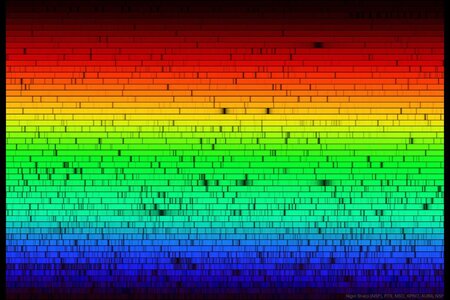
This is an astronomical spectrograph of our sun’s visible spectrum
Notice that there’s lots of missing light there, various fequencies that correspond to various atoms and molecules in the suns outer outmosphere. Those atoms and molecules absorb very specific frequencies and bands of frequencies (doppler effect also broadens some if not all lines and bands but that’s not important to this question).
There’s a lot of missing frequencies there. I remember reading about UV-A, B and C and the different effects that the different frequencies cause. I imagine that there are gaps in the non-visible ferquency bands just like the visible light gaps. Could we improve LED performance (or actually, plant performance under LED), if we could accurately replicate ^that fequency absorbtion pattern?
Is it possible that little short bands of radiation or gaps in said radiation is important to the plants? Kind of like certain nutrients and minerals can inhibit or enhance uptake of various nutrients, can absence or presence of certain light frequencies affect efficiency of other fequencies (almost an inverse to the emmerson effect).