Bud Builders - Making Friends, Growing Cannabis

Register a free account today to become a Bud Builders member! Once signed in, you'll be able to participate on our site by adding your own topics and posts, as well as connect with other members through your own private inbox.

Join the fun and make some friends!

Girls Gone Wild - Cannabis Flowering with Supplemental Red Lighting

That's a great idea! Be nice to be mandatory for my wife.......I'm trying to see if I can get a firmware update for my old one....probably not but worth a try.

Yeah me too...I'm just 15mins before and after main and 15 more with main for 60mins total of ir/far red. I cut my red back also for a couple hours midday since I had to turn the main down to 65% to avoid cooking the Glue Sniffers. I'm curious to see what the ratios are actually like.

You have to go on down the rabbit hole and add uva and 660nm red to be able to use your new par meters full potential! lol
I've got a lot of 660 nm reds already in there. I didn't change the timing on those. I have 110 watts of recently added deep reds to go with what came with my lights. I also have 8 660nm/730nm emerson boards in there on the same timer as my main lights.

As for the UV? I have UVA, UVB, and even UVC sources that I could add. (UVC is more of a germicidal light for sterilizing the tent between grows) I am more than likely going to add UVA and UVB for the next run. It would be a lot of work to do right now without moving the plants.
 
I added both to my Amazon cart. I'm going to apply the 24 hr rule though. The 24 hr rule means I will think about it for a day to decide if I actually want to make the purchase.

Thanks for the tip though. I did some more reading about far red during flowering and its impact on over-all cannabinoids and decided to play it safe. I changed the timing on the far reds to 20 minutes before lights on and turning off right after the main lights come on and then turning it back on at lights out and running it for a half hr after the main light goes off. I don't want to sacrifice cannabinoids for the sake of an experiment. lol
I added both to my Amazon cart. I'm going to apply the 24 hr rule though. The 24 hr rule means I will think about it for a day to decide if I actually want to make the purchase.

Thanks for the tip though. I did some more reading about far red during flowering and its impact on over-all cannabinoids and decided to play it safe. I changed the timing on the far reds to 20 minutes before lights on and turning off right after the main lights come on and then turning it back on at lights out and running it for a half hr after the main light goes off. I don't want to sacrifice cannabinoids for the sake of an experiment. lol
I still plan to run them after 4 weeks in flower for 15 min aft lights out. I didn't see anything like that with that study, They used increasing percentage of reds with the reg lights and the more red the worse the outcome

. I saw another online from Microgrower and he used all reds or all blue or full spectrum & the blue was the worst if I remember right but regardless they ran Red, Blue & full spectrum through the full test not 15 min at lights out

I see a remarkable difference with just 15 min of 100% Far Red after just 1 week of use. I could see using them in high percentages over a long grow cycle as detrimental to the overall outcome but short burst here and there should help not hurt.....

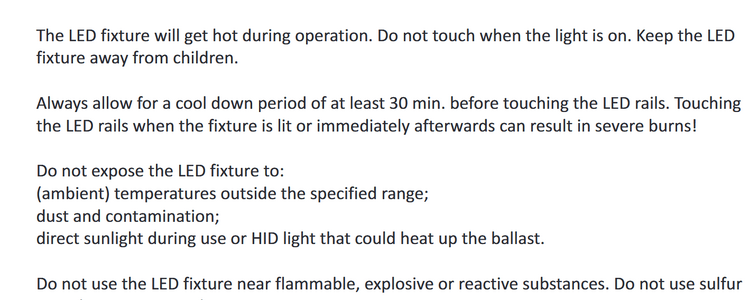
I wish I could use them a bit more than I already do. I really like the looks of my plants after a weeks worth. I'm anxious for the Blues to show up...Not sure how I'll use them yet....the manual says they get hot and not to touch???......only 30 watts I'm surprised theres a heat warning.....I can use the added heat 10 months of the year so bonusheat...lol1742052382728.png
 
I still plan to run them after 4 weeks in flower for 15 min aft lights out. I didn't see anything like that with that study, They used increasing percentage of reds with the reg lights and the more red the worse the outcome

. I saw another online from Microgrower and he used all reds or all blue or full spectrum & the blue was the worst if I remember right but regardless they ran Red, Blue & full spectrum through the full test not 15 min at lights out

I see a remarkable difference with just 15 min of 100% Far Red after just 1 week of use. I could see using them in high percentages over a long grow cycle as detrimental to the overall outcome but short burst here and there should help not hurt.....

I wish I could use them a bit more than I already do. I really like the looks of my plants after a weeks worth. I'm anxious for the Blues to show up...Not sure how I'll use them yet....the manual says they get hot and not to touch???......only 30 watts I'm surprised theres a heat warning.....I can use the added heat 10 months of the year so bonusheat...lolView attachment 93287

Reading between the lines ... You probably don't want your plants touching the new blue lights then.
 
I found this inexpensive par meter that breaks down red, green, and blue.
Doesn't do far red or uva though...but found this for that
It would make it possible to get ratios dialed in pretty damn close....I have the old style of the first one but it doesn't separate the spectrum....Claude will be very helpful with this!
I looked, there's no equivalent up here and I'm not spending a few hundred on another tool I won't use more than once or twice then the batteries die and they sit in my bookshelf gathering dust, I'm fighting this hard. I have my foot down NO MORE TOOLS ! No More Tools....no more tools.....ah shit
 
Reading between the lines ... You probably don't want your plants touching the new blue lights then.
I don't want anything touching them they get that hot. I hope its just a translation issue. They are From Vancouver Island after all and they speak funny over there. There a bunch of Kale eaters living out there and I think it gives them a lisp.....Can't trust them Kale eaters & their healthy fkin lifestyle. I hope they make good lights though but I just took out a light that got too hot..??? I'm confused now.
 
I don't want anything touching them they get that hot. I hope its just a translation issue. They are From Vancouver Island after all and they speak funny over there. There a bunch of Kale eaters living out there and I think it gives them a lisp.....Can't trust them Kale eaters & their healthy fkin lifestyle. I hope they make good lights though but I just took out a light that got too hot..??? I'm confused now.
Pretty well every LED light says the same warnings not to touch will be hot
 
I looked, there's no equivalent up here and I'm not spending a few hundred on another tool I won't use more than once or twice then the batteries die and they sit in my bookshelf gathering dust, I'm fighting this hard. I have my foot down NO MORE TOOLS ! No More Tools....no more tools.....ah shit
1742055491787.jpeg
 
Got an email ad from Migro talking about far red in flower....linked to this page.....they're not a fan.
Sorry I didn't see someone had already linked this.
They used 25% far red...
I received the same email. @Observer also brought it up. Because of that, I took the 60 watts of far red and put it on a different time schedule. It's now running my 730nm far reds for 20 minutes before lights on, shutting off when the main lights come on and then turning on for a half hour when the main light turns off. All other light timing schedules remain the same. I'll also be turning off 110w of 440nm blue once I finish the stretch. At that point, I'll turn my 630w main light from 525w to 630w to offset the DLI change. I'm beginning week 3 of flower as of yesterday. I should be pretty much done with the stretch by next weekend.

Today, I'm going to post some new pictures taken earlier when I was feeding them and giving them another small round of defoliating. I'll finish the lollipopping over the next few days when I take another round of cuttings for my aerocloner. I purchased a tissue culture kit but the area I will be using for that is not ready yet ... so one more round of clones in the aerocloner ...

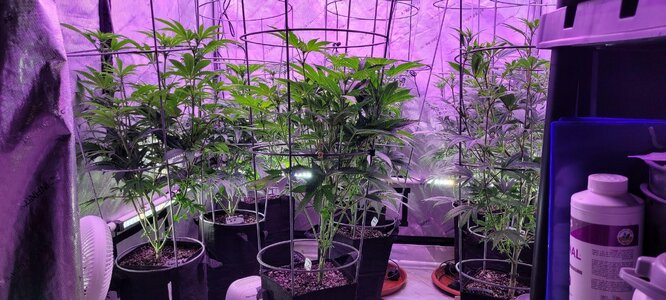
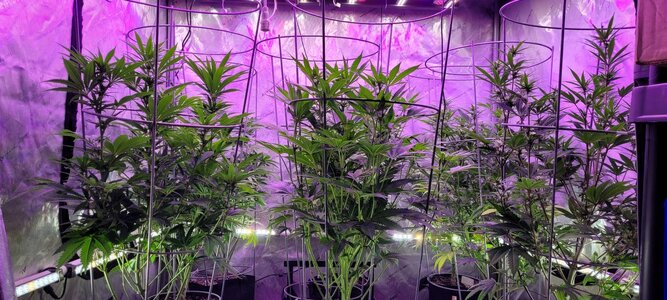
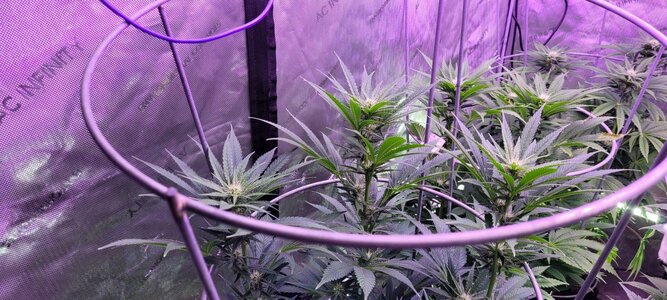
Here's a picture of all 9 lovely ladies ...

03.16.2025.jpg

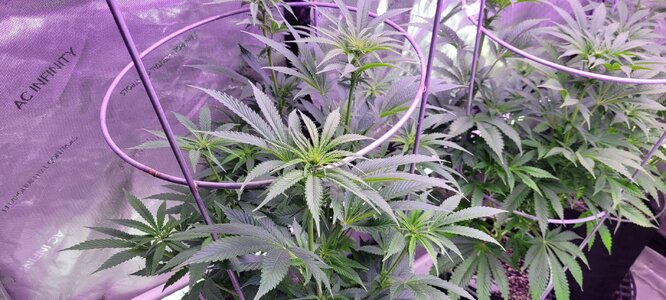
Left to right I have 3 each of Gorilla Road Kill, Dante's Inferno, and Lemon Grass.


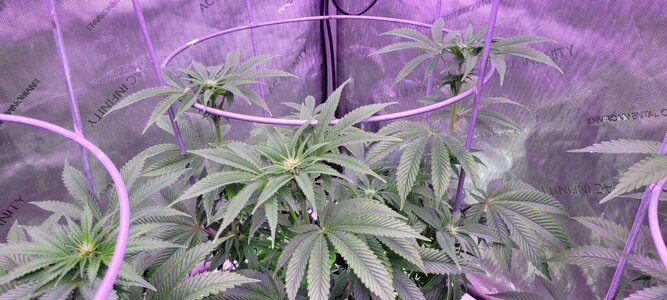
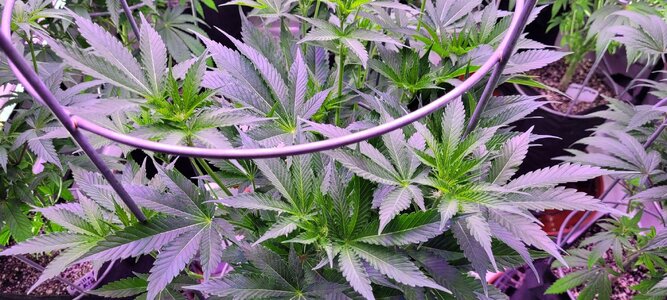
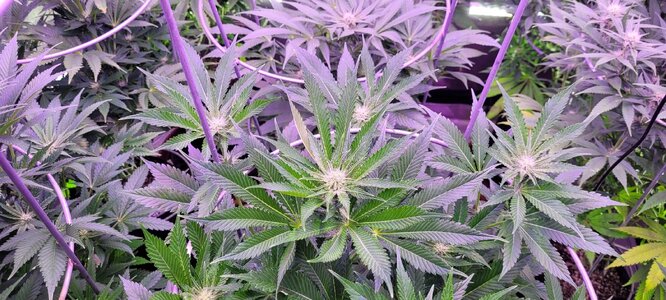
Here's a few close ups of the Gorilla Road Kill from above.

GRK1.03.16.2025.jpgGRK2.03.16.2025.jpgGRK3.03.16.2025.jpg

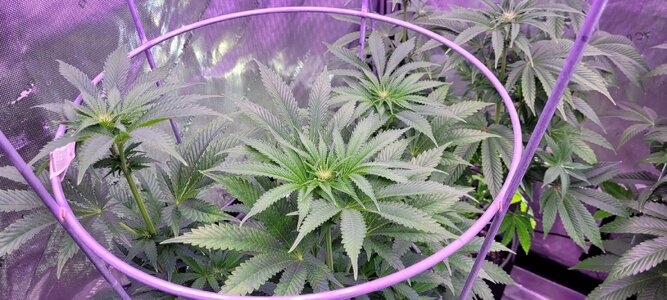
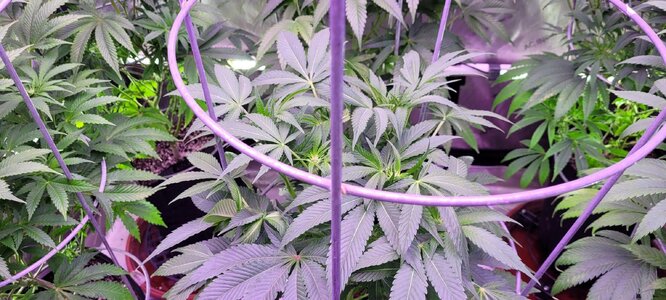
Next are my Dante's Inferno

DI1.03.16.2025.jpgDI2.03.16.2025.jpgDI3.03.16.2025.jpg

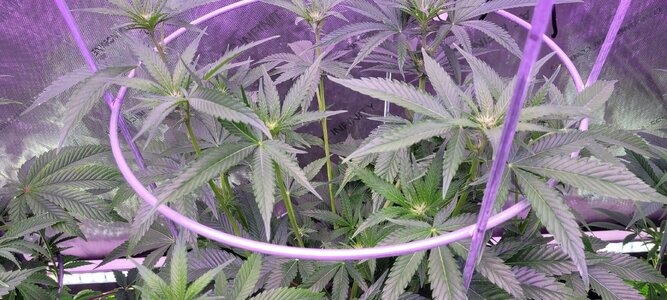
And last are my Lemon Grass

LG1.03.16.2025.jpgLG2.03.16.2025.jpgLG3.03.16.2025.jpg

It's been a busy day ... I still have clones to transplant and get ready for shipping. I'll get Claude involved again sometime soon.
 
I received the same email. @Observer also brought it up. Because of that, I took the 60 watts of far red and put it on a different time schedule. It's now running my 730nm far reds for 20 minutes before lights on, shutting off when the main lights come on and then turning on for a half hour when the main light turns off. All other light timing schedules remain the same. I'll also be turning off 110w of 440nm blue once I finish the stretch. At that point, I'll turn my 630w main light from 525w to 630w to offset the DLI change. I'm beginning week 3 of flower as of yesterday. I should be pretty much done with the stretch by next weekend.

Today, I'm going to post some new pictures taken earlier when I was feeding them and giving them another small round of defoliating. I'll finish the lollipopping over the next few days when I take another round of cuttings for my aerocloner. I purchased a tissue culture kit but the area I will be using for that is not ready yet ... so one more round of clones in the aerocloner ...

Here's a picture of all 9 lovely ladies ...

View attachment 93598

Left to right I have 3 each of Gorilla Road Kill, Dante's Inferno, and Lemon Grass.


Here's a few close ups of the Gorilla Road Kill from above.

View attachment 93599View attachment 93600View attachment 93601

Next are my Dante's Inferno

View attachment 93602View attachment 93603View attachment 93604

And last are my Lemon Grass

View attachment 93605View attachment 93606View attachment 93607

It's been a busy day ... I still have clones to transplant and get ready for shipping. I'll get Claude involved again sometime soon.
I'm still pondering that migro article.
 
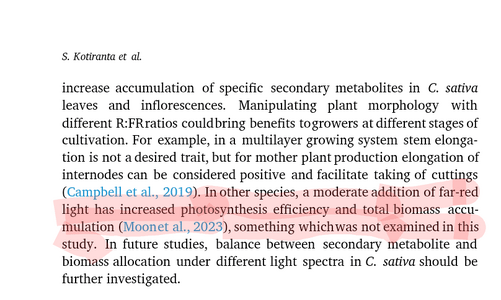
Trying to go through that study and not sure I follow this last part correctly. I guess it's saying that usually far red is good, for other species.Screenshot_20250317-191441~2.png

I can't get over the dramatic changes in morphology in the pictures in the study. Like obviously that is too much far red if it looks like a Charlie Brown Christmas tree.

This study is a hard pill to swallow
 
Trying to go through that study and not sure I follow this last part correctly. I guess it's saying that usually far red is good, for other species.View attachment 93735

I can't get over the dramatic changes in morphology in the pictures in the study. Like obviously that is too much far red if it looks like a Charlie Brown Christmas tree.

This study is a hard pill to swallow
I'm interested in hearing where all this is leading us. Being able to utilize the different light frequencies to manipulate how cannabis grows has been fascinating so far. I wonder what Dr. Bugbee has to say on the topic?

Edit:

I asked Claude -

What does Dr. Bruce Bugbee have to say about 730nm far red and cannabinoid production

Based on my knowledge up until October 2024, Dr. Bruce Bugbee, a plant physiologist at Utah State University known for his research on controlled environment agriculture, has discussed far-red light (around 730nm) and its effects on plant growth, including cannabis.
From what I understand, Dr. Bugbee has found that far-red light can influence plant morphology and flowering responses, but regarding specific effects on cannabinoid production, his research has shown:

  1. Far-red light (730nm) can increase plant size and leaf expansion, which can indirectly impact total cannabinoid yield per plant.
  2. He has noted that while far-red light influences plant stretching and can increase overall biomass accumulation, the direct relationship between far-red exposure and cannabinoid concentration (THC, CBD percentages) is more complex.
  3. Dr. Bugbee generally emphasizes that the ratio of different wavelengths (including red, blue, and far-red) matters more than any single wavelength in isolation for optimizing plant growth and secondary metabolite production.
If you're looking for very specific findings about Dr. Bugbee's most recent research on 730nm far-red light and cannabinoid production, I should note that my information might not include his most recent studies or statements if they were published after my October 2024 knowledge cutoff. For the most current information, you might want to check his recent publications or presentations.

@ninjadip - It sounds like there's still much to learn on this
 
Last edited:
What is the ratio of different wavelengths of red, blue, and far-red

Based on Dr. Bruce Bugbee's research, there isn't one universal "ideal" ratio of red, blue, and far-red wavelengths for cannabis cultivation, as optimal light spectrum can vary depending on growth stage and desired outcomes. However, from his work, some general principles emerge:
For vegetative growth and cannabinoid production, Dr. Bugbee's research suggests:

  • Red light (around 660nm): Generally the highest proportion, often 60-80% of the total photon flux
  • Blue light (around 450nm): Typically 10-20% of the total photon flux
  • Far-red light (around 730nm): Used more sparingly, often 5-15% of the total photon flux
Some key points from his findings:
  1. Red light is highly efficient for photosynthesis and is the primary driver of biomass production
  2. Blue light helps control plant height/stretching and can influence secondary metabolite production
  3. Far-red light affects morphology (typically causing stretching) and can influence flowering responses
 
Claude AI intelligence cut-off date was apparently last October.

Here's ChatGPT's answer about Dr Bugbee's studies on 700nm+ far reds

What are the findings from Dr. Bugbee's most recent research on 730nm far-red light and cannabinoid production

Dr. Bruce Bugbee's research has significantly advanced our understanding of far-red light (specifically around 730 nm) and its effects on plant growth. His studies indicate that far-red photons are as effective as red photons in driving photosynthesis, challenging traditional definitions of photosynthetically active radiation (PAR) that typically exclude wavelengths beyond 700 nm.
frontiersin.org

When it comes to cannabis cultivation, the application of far-red light requires careful consideration. Dr. Bugbee notes that while far-red light can enhance photosynthesis, it also promotes stem elongation—a trait undesirable during the flowering stage of short-day plants like cannabis. Excessive stem elongation can lead to weaker stems and potentially reduced yields. Therefore, the timing and intensity of far-red light exposure are crucial factors to manage.
neocisiongrowlights.com

Regarding cannabinoid production, current research, including studies referenced by Dr. Bugbee, suggests that while far-red light influences plant morphology and growth rates, there is no conclusive evidence that it directly affects cannabinoid content. A study published in Frontiers in Plant Science concluded that ultraviolet radiation did not impact yield or cannabinoid levels in indoor-grown cannabis.
neocisiongrowlights.com
This finding implies that while light spectrum manipulation can optimize growth conditions, it may not directly alter cannabinoid synthesis.

In summary, Dr. Bugbee's research highlights the potential benefits and considerations of incorporating far-red light into cannabis cultivation. While it can enhance photosynthesis and influence plant morphology, its direct impact on cannabinoid production remains unsubstantiated. Growers should apply far-red light judiciously, considering the specific growth stages and desired plant characteristics to avoid unintended effects like excessive stretching.
For a more in-depth understanding, you might find this video informative:


i heard/ hypothesized UV may have more of an effect on plants that evolved at higher elevations, due to UV getting through the atmosphere "easier" , as its thinner, and does not block as much radiation.
 
i heard/ hypothesized UV may have more of an effect on plants that evolved at higher elevations, due to UV getting through the atmosphere "easier" , as its thinner, and does not block as much radiation.
That's quite possible. The study did not say UV light has no effect. It says it didn't make a noticeable difference in an indoor cannabis grow. The variables might be different with UV at high elevation ... @Observer I can get behind that hypothesis. Has there been any recent studies of outdoor cannabis and uv exposure when grown at high elevations?
 
That's quite possible. The study did not say UV light has no effect. It says it didn't make a noticeable difference in an indoor cannabis grow. The variables might be different with UV at high elevation ... @Observer I can get behind that hypothesis. Has there been any recent studies of outdoor cannabis and uv exposure when grown at high elevations?
ill try to find where i saw that at
 
ill try to find where i saw that at
Here's what Claude AI had to say ...

Has there been any recent studies of outdoor cannabis and uv exposure when grown at high elevations.

Based on my knowledge up to October 2024, there have been some studies examining the relationship between UV exposure, elevation, and cannabis cultivation, though this remains an area with ongoing research.
Key findings from research in this area include:

  1. Higher elevations naturally expose plants to increased UV radiation due to the thinner atmosphere filtering less UV light. Cannabis grown at high elevations (above 5,000-6,000 feet) is subjected to significantly more UV-B radiation than plants at sea level.
  2. There's evidence suggesting that cannabis responds to increased UV exposure (particularly UV-B) by producing more secondary metabolites, including cannabinoids and terpenes, as a protective mechanism. This is consistent with the plant's natural defense response to environmental stressors.
  3. Some studies have found that cannabis varieties grown at higher elevations in places like the Hindu Kush mountains, parts of Jamaica, and high-altitude regions of South America often develop distinctive chemotypes with potentially higher THC or CBD concentrations.
  4. Research has indicated that the combination of intense light (including UV), temperature fluctuations, and other environmental factors at high elevations can contribute to unique phytochemical profiles in cannabis.
One limitation in this research area is that many studies have been conducted in controlled environments attempting to simulate high-elevation conditions rather than field studies at actual high elevations. Additionally, the legal status of cannabis has historically limited large-scale, systematic outdoor cultivation studies.
If you're interested in very recent research published after my knowledge cutoff date, you might want to check recent publications in journals focusing on plant science, agriculture, or cannabis-specific scientific publications.
 
ill try to find where i saw that at

Here's what ChatGPT had to say:

Has there been any recent studies of outdoor cannabis and uv exposure when grown at high elevations.

Recent studies have explored the effects of ultraviolet (UV) radiation on cannabis plants, though specific research on outdoor cultivation at high elevations remains limited. In controlled indoor environments, increased UV exposure has been linked to various plant responses. For instance, a study found that higher UV levels led to reduced plant size, leaf malformations, and decreased photosynthetic rates, without significant benefits to cannabinoid concentrations.
frontiersin.org

Another investigation reported minimal effects on cannabinoid content when plants were subjected to elevated UV photon fluxes, suggesting that higher UV levels do not necessarily enhance cannabinoid synthesis.
frontiersin.org

While direct studies on outdoor cannabis cultivation at high elevations are scarce, it's known that UV radiation intensity increases with altitude. This heightened UV exposure can influence cannabis plants, potentially affecting resin production and secondary metabolite profiles. However, excessive UV exposure may also harm plant health, causing issues like sunburn.
floraflex.com

Additionally, cannabis strains adapted to high-altitude environments often exhibit unique characteristics, such as lighter-colored leaves to reflect intense sunlight and enhanced cannabinoid and terpene profiles.
mountainanniescannabis.com

In summary, while indoor studies provide insights into UV radiation's impact on cannabis, more research is needed to fully understand how outdoor cultivation at high elevations affects plant development and chemical composition.
 
Here's what ChatGPT had to say:

Has there been any recent studies of outdoor cannabis and uv exposure when grown at high elevations.

Recent studies have explored the effects of ultraviolet (UV) radiation on cannabis plants, though specific research on outdoor cultivation at high elevations remains limited. In controlled indoor environments, increased UV exposure has been linked to various plant responses. For instance, a study found that higher UV levels led to reduced plant size, leaf malformations, and decreased photosynthetic rates, without significant benefits to cannabinoid concentrations.
frontiersin.org

Another investigation reported minimal effects on cannabinoid content when plants were subjected to elevated UV photon fluxes, suggesting that higher UV levels do not necessarily enhance cannabinoid synthesis.
frontiersin.org

While direct studies on outdoor cannabis cultivation at high elevations are scarce, it's known that UV radiation intensity increases with altitude. This heightened UV exposure can influence cannabis plants, potentially affecting resin production and secondary metabolite profiles. However, excessive UV exposure may also harm plant health, causing issues like sunburn.
floraflex.com

Additionally, cannabis strains adapted to high-altitude environments often exhibit unique characteristics, such as lighter-colored leaves to reflect intense sunlight and enhanced cannabinoid and terpene profiles.
mountainanniescannabis.com

In summary, while indoor studies provide insights into UV radiation's impact on cannabis, more research is needed to fully understand how outdoor cultivation at high elevations affects plant development and chemical composition.
i said it here for some reason, i dont think i came up with that hypothesis, maybe i did, but i thought i read it in a another paper or somewhere.

still digging.


1742259270521.png


so really I/ someone needs to take plants that grew/evolved on the hindu kush mountain range for instance, and then just some other genes that grew at lower elevation, then use UV on those plants in controlled environments, and see what the difference/results are.
 
Key Points:

  • High-Elevation Adaptations:
    • Plants in high-altitude environments have undergone evolutionary adaptations to withstand intense UV radiation, among other stressors. These adaptations often involve genetic modifications that enhance their ability to produce protective compounds.
    • Studies show that these plants frequently exhibit increased production of flavonoids, which act as natural UV protectants. This is a genetic trait that has been selected for over generations.
  • UV and Genetic Expression:
    • UV radiation can trigger changes in gene expression in plants. This means that exposure to UV can activate or deactivate certain genes, leading to changes in the plant's physiology and biochemistry.
    • In plants with high-elevation adaptations, the genes responsible for flavonoid production are often more readily activated by UV exposure. This suggests that their genetic makeup is optimized to respond to UV stress.
  • UV LEDs and Research:
    • The use of UV LEDs in plant research is becoming increasingly common. This technology allows researchers to precisely control the intensity and wavelength of UV radiation, enabling them to study its effects on plants in a controlled environment.
    • Researchers are using UV LEDs to investigate:
      • The effects of different UV wavelengths on plant growth and development.
      • The mechanisms by which plants perceive and respond to UV radiation.
      • The role of UV in the production of secondary metabolites, such as flavonoids and cannabinoids.
    • It is very important to note that the effects of UV light are very dependant on the specific wavelengths of UV light being used. UV-A, UV-B, and UV-C all have very different effects on plant life.
  • Genetic Predisposition:
    • It is very likely that plants that have genetics that have evolved in high altitude environments, will have a greater ability to deal with UV radiation. This is due to the fact that over many generations, those plants that could not deal with the radiation, would die off, and those that could, would reproduce. Thus leading to a genetic line of plants that are better suited to high UV environments.
In summary:

  • The idea that plants with high-elevation genetics respond differently to UV is supported by scientific evidence.
  • UV LEDs are valuable tools for studying these interactions.
  • It is important to remember that UV radiation effects plant life in very complex ways
 
Key Points:

  • High-Elevation Adaptations:
    • Plants in high-altitude environments have undergone evolutionary adaptations to withstand intense UV radiation, among other stressors. These adaptations often involve genetic modifications that enhance their ability to produce protective compounds.
    • Studies show that these plants frequently exhibit increased production of flavonoids, which act as natural UV protectants. This is a genetic trait that has been selected for over generations.
  • UV and Genetic Expression:
    • UV radiation can trigger changes in gene expression in plants. This means that exposure to UV can activate or deactivate certain genes, leading to changes in the plant's physiology and biochemistry.
    • In plants with high-elevation adaptations, the genes responsible for flavonoid production are often more readily activated by UV exposure. This suggests that their genetic makeup is optimized to respond to UV stress.
  • UV LEDs and Research:
    • The use of UV LEDs in plant research is becoming increasingly common. This technology allows researchers to precisely control the intensity and wavelength of UV radiation, enabling them to study its effects on plants in a controlled environment.
    • Researchers are using UV LEDs to investigate:
      • The effects of different UV wavelengths on plant growth and development.
      • The mechanisms by which plants perceive and respond to UV radiation.
      • The role of UV in the production of secondary metabolites, such as flavonoids and cannabinoids.
    • It is very important to note that the effects of UV light are very dependant on the specific wavelengths of UV light being used. UV-A, UV-B, and UV-C all have very different effects on plant life.
  • Genetic Predisposition:
    • It is very likely that plants that have genetics that have evolved in high altitude environments, will have a greater ability to deal with UV radiation. This is due to the fact that over many generations, those plants that could not deal with the radiation, would die off, and those that could, would reproduce. Thus leading to a genetic line of plants that are better suited to high UV environments.
In summary:

  • The idea that plants with high-elevation genetics respond differently to UV is supported by scientific evidence.
  • UV LEDs are valuable tools for studying these interactions.
  • It is important to remember that UV radiation effects plant life in very complex ways

I would agree with this ...

i dont think anyone has done the study i mentioned.

Maybe not ... at least not yet that we know of. UV is a hot topic so I'm sure there's new studies on their way to being published right now.
 
so that video, according to research/test/experiments , they are saying they have not seen any THC increase from 400um wavelength uv or less, which makes me sad lol
he did say, they see anthocyanins going up from the UV

but dont think they specified exactly what wavelength of UV they used.

i think the UV needs to be closer to the uv-C Range but idk, and then ofc that gets "dangerous" (strictly looking for THC increases from UV)
 
so that video, according to research/test/experiments , they are saying they have not seen any THC increase from 400um wavelength uv or less, which makes me sad lol
Still has beneficial germicidal properties right? Like helping to minimize PM?
I really believed, I guess now bro science, that UV could help the plant to produce more oils because of it. Like how humans need UV to produce vitamin D, not enough and we get vitamin D defencies. Just thought there has to be a similar synergistic effect with plants.
Wishing doesn't make science right lol
But there must be more to it
 
Still has beneficial germicidal properties right? Like helping to minimize PM?
I really believed, I guess now bro science, that UV could help the plant to produce more oils because of it. Like how humans need UV to produce vitamin D, not enough and we get vitamin D defencies. Just thought there has to be a similar synergistic effect with plants.
Wishing doesn't make science right lol
But there must be more to it
It seems to me that nature supplies what nature requires.
I would think, that would indicate that if we could perfectly replicate the wavelength ratios that sunlight has, with artificial lighting, we would probably have the best environment.

To me, that seems to indicate that some UV (as well as IR) all add to the end product. It may not be photosynthetic, but could be pest control as Ninja mentions, or perhaps the rays act as catalysts for better function of photosynthetic wavelengths.

In short, it's the entire package that makes the difference.
 
Key Points:

  • High-Elevation Adaptations:
    • Plants in high-altitude environments have undergone evolutionary adaptations to withstand intense UV radiation, among other stressors. These adaptations often involve genetic modifications that enhance their ability to produce protective compounds.
    • Studies show that these plants frequently exhibit increased production of flavonoids, which act as natural UV protectants. This is a genetic trait that has been selected for over generations.
  • UV and Genetic Expression:
    • UV radiation can trigger changes in gene expression in plants. This means that exposure to UV can activate or deactivate certain genes, leading to changes in the plant's physiology and biochemistry.
    • In plants with high-elevation adaptations, the genes responsible for flavonoid production are often more readily activated by UV exposure. This suggests that their genetic makeup is optimized to respond to UV stress.
  • UV LEDs and Research:
    • The use of UV LEDs in plant research is becoming increasingly common. This technology allows researchers to precisely control the intensity and wavelength of UV radiation, enabling them to study its effects on plants in a controlled environment.
    • Researchers are using UV LEDs to investigate:
      • The effects of different UV wavelengths on plant growth and development.
      • The mechanisms by which plants perceive and respond to UV radiation.
      • The role of UV in the production of secondary metabolites, such as flavonoids and cannabinoids.
    • It is very important to note that the effects of UV light are very dependant on the specific wavelengths of UV light being used. UV-A, UV-B, and UV-C all have very different effects on plant life.
  • Genetic Predisposition:
    • It is very likely that plants that have genetics that have evolved in high altitude environments, will have a greater ability to deal with UV radiation. This is due to the fact that over many generations, those plants that could not deal with the radiation, would die off, and those that could, would reproduce. Thus leading to a genetic line of plants that are better suited to high UV environments.
In summary:

  • The idea that plants with high-elevation genetics respond differently to UV is supported by scientific evidence.
  • UV LEDs are valuable tools for studying these interactions.
  • It is important to remember that UV radiation effects plant life in very complex ways
Hey, I've been reading along here. one thing I don't see mentioned is that we give 12 noon high intensity lighting from wake to dark. Out doors the sun is at different angles providing different spectrum's and intensity, would that not also be hard to replace in studies done indoors.

The high altitude plants may only get 2-3 days of good sun a week with possible extreme fluctuating temperatures effecting the plants development of metabolite, flavonoids, cannabinoids and such. I've got a suspicion that low intensity lighting produces more frost. So many variables its hard to track down the recipe but its fun trying.
 
Trying to go through that study and not sure I follow this last part correctly. I guess it's saying that usually far red is good, for other species.View attachment 93735

I can't get over the dramatic changes in morphology in the pictures in the study. Like obviously that is too much far red if it looks like a Charlie Brown Christmas tree.

This study is a hard pill to swallow
They went with 25% ir I think I read.....we're no where close to that. The old blurple lights were all red and blues and they did fine...ish
 
Update time ...

Day 23 of flowering.

03.23.2025.jpg

I did some more lollipopping . I'm probably done lollipopping but intend to do another round or 2 of strategic defoliation as needed as we approach the mid flower stage of development.

RKS.03.23.2025.jpg

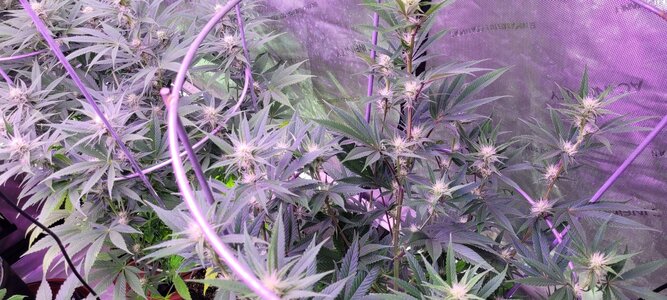
Here's a close-up of one of my Gorilla Roadkill Skunks. Flowers are stacking nicely.

DI.03.23.2025.jpg

Here's a close-up of one of my Dante's Infernos.

LG.03.23.2025.jpg

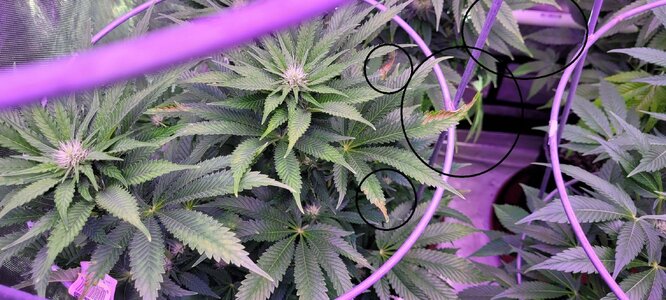
And here's one of my LemonGrass plants. All plants are healthy. No real complaints about how things are progressing at this stage. I am contemplating removing some of the blue light from the mix and pumping up the light intensity of the main light. I tried to bump the main light earlier in the week without taking out some of the color and ended up with a bit of light burn. I promptly turned the intensity back down again once I noticed it ...

Lightburn.03.23.2025.jpg

Here's a picture of the light burned leaves. It kind of mimics magnesium deficiency except that its higher up on the plant.
 
Last edited:
Back
Top Bottom