Bud Builders - Making Friends, Growing Cannabis

Register a free account today to become a Bud Builders member! Once signed in, you'll be able to participate on our site by adding your own topics and posts, as well as connect with other members through your own private inbox.

Join the fun and make some friends!

nah, did that before and keeping the environment in check was a motherfucker. i had it dialed in last round, but i also wasn't running a carbon filter. i gotta dig through my electronics shit and see if i still have the other fan controller. if i do, i'll get this working right.

even if i had all the vents open on the tent, the t6 pulls so much air the tent ends up with the sides sucked in like a hooker giving a client her grade A work. plus, light blasting into the night isn't good for opsec.

i picked up some vent filter material when i grabbed the manifold, so imma fuck with that and see if it performs better than the tights the lady brought home. i asked for pantyhose and she brought home tights. dunno how a simple instruction of "cheapest pantyhose you can find, black preferably" turned into "let's buy him quality tights." and, before y'all ask, if i choose to wear tights or pantyhose, y'all would be blessed to witness it in person. it's important to stay in touch with your feminine side 😝
I use nylon knee-highs. (Had to ask wifey what she calls them.) Dollar store mostly. Work great as filters for T6 and S6 in-line. Just vacuum and replace each grow.

My feminine sides just fine, sleeps beside me, most nights. 🤣
 
Mich figured out how to do legalization somewhat sensibly. I don't think any other state has anywhere near as rational laws, at least out of the legal states.
It's 12 plants per household or 12 plants per med card holder, which can really expand the number of plants someone has. With Michigan laws, anyone over the age of 50 can easily find some ailment to qualify. Many people under 50 can also do it.

When pheno hunting, it's really nice to double that maximum.
 
if only WA govt would remove head from anus and allow rec grows, then I could quit being old school. The ONLY reason I'm running a carbon filter is because the kids started school and after the last run I was walking around smelling like I was rolling around with the ladies, and not the ambrosia type. Had a clerk at a gas station ask me if I'd just finished some devil's lettuce (I don't even consume anymore) and realized, well fuck. If I smell like weed, then that means my kids do too. My kids go to school smelling like weed, CPS shows up. CPS shows up, I get busted. Soooo... here we are.

Plus, apparently I didn't do enough due diligence before buying the property I did, because 142 ft from my house lives a sheriff. It's awesome.
Dude I feel for you. But it’s funny as shit. 🤣

Seriously not laughing at you. Just how life turns out. Makes me feel better about my shit, knowing it gets spread far and wide and not personal. 😝

I forget I go nose blind and wonder why I get looks here/there. Then I remember I’m in flower and in the tent at lights out 7am…before going shopping. 🤣

Be safe my man. 👍
 
I use nylon knee-highs. (Had to ask wifey what she calls them.) Dollar store mostly. Work great as filters for T6 and S6 in-line. Just vacuum and replace each grow.

My feminine sides just fine, sleeps beside me, most nights. 🤣
That's what I fucking wanted, and she brought me tights. I asked her, "WTF are these? The weave is way too tight to do that I need." And she said, "don't send a woman to buy you pantyhose if you don't want quality." I mean, she has a point but not the same point I have lol

Luckily this vent filter material I picked up isn't nearly as restrictive and I've got the sides of the tent pulled in mildly instead of looking like it's been hitting the crack pipe for a while.
 
That's what I fucking wanted, and she brought me tights. I asked her, "WTF are these? The weave is way too tight to do that I need." And she said, "don't send a woman to buy you pantyhose if you don't want quality." I mean, she has a point but not the same point I have lol

Luckily this vent filter material I picked up isn't nearly as restrictive and I've got the sides of the tent pulled in mildly instead of looking like it's been hitting the crack pipe for a while.
Bro my 3x3 looks like a 20 year crack veteran. 😳
Only thing that stops it is my 34x34 bar light, but you can see the light imprinted in the sides of the tent...
Really need to get a high cfm kit and vent filters for this time of year. My aci exhaust fans run 24/7 at 8 or 10.... that shit sounds so terrible too.
 
Bro my 3x3 looks like a 20 year crack veteran. 😳
Only thing that stops it is my 34x34 bar light, but you can see the light imprinted in the sides of the tent...
Really need to get a high cfm kit and vent filters for this time of year. My aci exhaust fans run 24/7 at 8 or 10.... that shit sounds so terrible too.
Hell yeah it does man. At the rental I was looking into ducting mufflers to try and reduce the sound of rushing air in the hallway closet, with was where I dumped the exhaust from the tent. Summer gets brutal man, especially when the fans are going full bore
 
IIRC my flavor of idiot is an idiot savant. damn smart in a handful of areas but my social functioning and decision making can be more than questionable at times :ROFLMAO:
Some
"don't send a woman to buy you pantyhose if you don't want quality." I mean, she has a point but not the same point I have lol.


Ahaha

My girl would say something similar
 
Should be ready to take clones on Saturday, maybe Sunday. The lady's brother is coming up to help me with some work on the Toyota on Saturday so likely won't get to cutting anything until after he leaves, or Sunday at the latest.

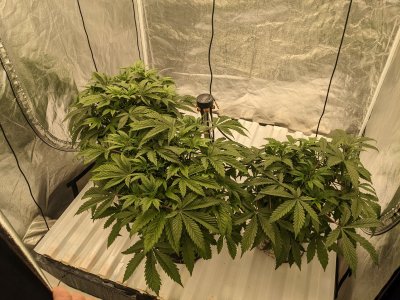
Almost show time y'all...
PXL_20230804_010323747.jpg
 
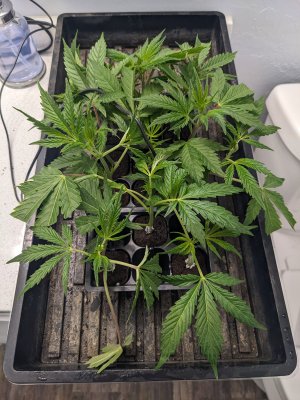
Clones cut, 🤞 for strong roots in the next seven to ten days, then can move the moms back to their closet.

Not sure I'll hold onto the moms, but will decide after roots break through the rooters and I see how aggressive these girls are gonna be.
 
And there were eight. Saturday will be the day the clones that are going to the final show will be selected.

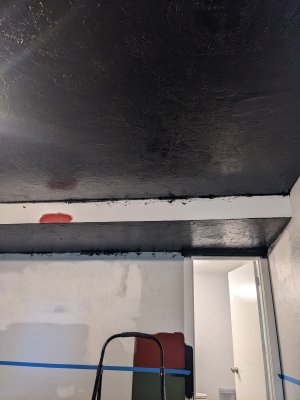
Also started the office transformation since getting the Ethernet cables pulled and holes patched. Don't judge the cut ins, I'm far from a professional painter and will clean everything up real nice when I lay down the red that's going on the top portion of the walls.. I also have some pretty cool shit planned for the ceiling, so before anyone jumps and asks why black -- I have my reasons. Stay tuned and you'll see.
PXL_20230818_010748091.jpgPXL_20230818_003636371.jpg
 
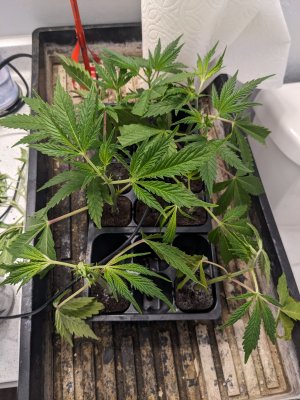
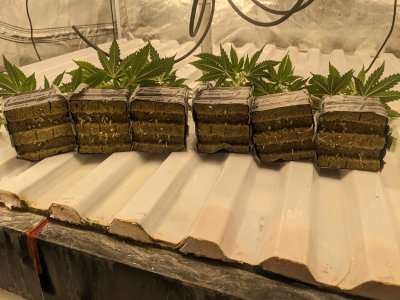
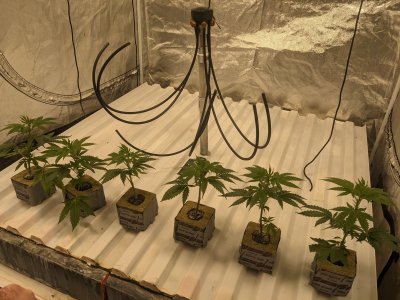
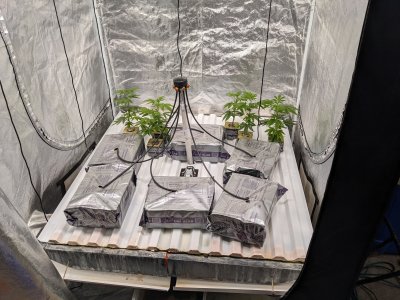
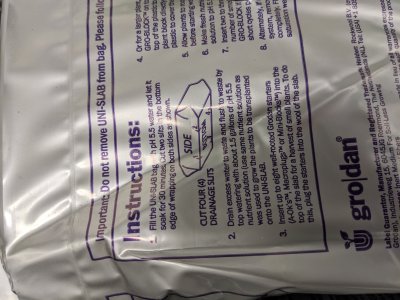
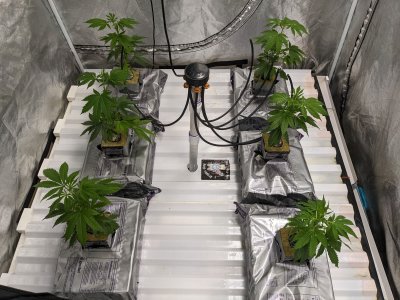
The line up is almost ready for unislabs

Currently getting 0.5 EC under ~15k lux (i know, not ppfd but i don't have an accurate way to measure light output other than my phone app), requiring watering every other day. Letting the deltas dry out a bit more than usual to try and force them roots to get more prolific. Will likely top em this weekend and start focusing on getting the branching worked out along with trying to get the plants all equal height before things really start to take off.

PXL_20230830_233901444.jpgPXL_20230830_233836788.jpg
 
The line up is almost ready for unislabs

Currently getting 0.5 EC under ~15k lux (i know, not ppfd but i don't have an accurate way to measure light output other than my phone app), requiring watering every other day. Letting the deltas dry out a bit more than usual to try and force them roots to get more prolific. Will likely top em this weekend and start focusing on getting the branching worked out along with trying to get the plants all equal height before things really start to take off.

View attachment 19378View attachment 19379
nice tobh.


planning after i move and get stable & situated ima get me one of those octo-things and set up a drip
 
nice tobh.


planning after i move and get stable & situated ima get me one of those octo-things and set up a drip
lol that is now the technical term for those. i'll send Rainbird the petition stating we demand they no longer call them manifolds and are now to always be referred to as octo-things
 
lol that is now the technical term for those. i'll send Rainbird the petition stating we demand they no longer call them manifolds and are now to always be referred to as octo-things
I vote, since there's six of 'em, we call it the sexto-thang 🤪
 
idk why the fuck its called an octo-"bubbler"

does it "bubble" lol?

its a drip distributor basically, or a manifold of drip lines
 
idk why the fuck its called an octo-"bubbler"

does it "bubble" lol?

its a drip distributor basically, or a manifold of drip lines
so, there are fittings called bubblers, and yes, they kind of do like a bubble type delivery, but not exactly. given i don't run any ends on my feed lines, this is just a manifold.
 
so, there are fittings called bubblers, and yes, they kind of do like a bubble type delivery, but not exactly. given i don't run any ends on my feed lines, this is just a manifold.
Ahh, thanks tobh.
 
Man, I'ma have to experiment with those slabs.

If only they had more than one slot for the smaller cubes.


Perhaps a grid of em, 2 plants each.
You can actually put up to four plants per slab for smaller crops. TBH these are oversized for my 4x4 but the usability is ridiculous. After this harvest I plant on growing peppers in these exact same slabs.

Iirc you can grow up to three different crops in the same slabs before you start running into concerning issues -- different as in cannabis, capsicums, then lettuces, for instance.
 
You can actually put up to four plants per slab for smaller crops. TBH these are oversized for my 4x4 but the usability is ridiculous. After this harvest I plant on growing peppers in these exact same slabs.

Iirc you can grow up to three different crops in the same slabs before you start running into concerning issues -- different as in cannabis, capsicums, then lettuces, for instance.
Oh ok cool. It appeared to me there was "one slot" in the middle and of course if you force or cut, it fucks with the rockwool structure (?)
 
Oh ok cool. It appeared to me there was "one slot" in the middle and of course if you force or cut, it fucks with the rockwool structure (?)
That hole is for preparing the slabs. Give me a couple hours and you'll see how I'll place the rooted 3" deltas on them.
 
Correction - up to eight plants in one slab
View attachment 19739
Sweet, thanks man.

Perfect.

That would be great, I could do something similar to my solo's

I'm planning out a high-density/compact grow/method/sog w.e

Like I mathematically can fit 420 solos in 25sqft, just for the Lols I guess, I want to do it just so I can see it and what happens, I'd have to go vertical but yeah.

210 bottom, "plat form midway", another 210.
The 420 solo cup grow

But this got me thinking about a grid of rockwool and loading them the fuck up.
 
So the only reason your using the bigger slabs is because you want them for your peppers after your harvest is done?
 
So the only reason your using the bigger slabs is because you want them for your peppers after your harvest is done?
i like their profile better than the traditional slabs and feel like the roots have a better space to do their thing than if I ran in just 4" blocks. I could run purely in 4" blocks but the root exposure would annoy me and would open up more risk than I'm willing to tolerate. i also like the isolation between plants, which you don't get with traditional slabs.

last year's run with the unislabs was my best to date in the tent. cleanup took less than an hour, and i ended up tilling those into the raised garden bed at my old house. with these i figure i might as well experiment a bit post harvest, and the thought of harvesting peppers in early march sounds pretty damn appealing.
 
i like their profile better than the traditional slabs and feel like the roots have a better space to do their thing than if I ran in just 4" blocks. I could run purely in 4" blocks but the root exposure would annoy me and would open up more risk than I'm willing to tolerate. i also like the isolation between plants, which you don't get with traditional slabs.

last year's run with the unislabs was my best to date in the tent. cleanup took less than an hour, and i ended up tilling those into the raised garden bed at my old house. with these i figure i might as well experiment a bit post harvest, and the thought of harvesting peppers in early march sounds pretty damn appealing.
Coco mat works much like your slabs.
 
Coco mat works much like your slabs.
don't get me wrong, i love me some coco. it was actually what moved me into hydro many moons ago. i just really like the cleanliness of hydro. since i've moved to the PNW, without fail, coco or peat-based medias lead to fungus gnats. haven't had issues with those in wool, dutch buckets, or F&D, and the cleanup from all these is almost as simple as taking shit outside and spraying it down with a hose, hitting it with bleach, rinsing it again, and letting it dry.
 
alright. now with the slabs getting their initial soak, time to start pulling up data and techniques. given my thread at the old place didn't have external links, which i relied on for figuring out things my guy @Dirtbag wasn't privy to, gonna change shit up a little.

Managing the rootzone: Irrigation volumes and EC, WC graphs​

A structured irrigation strategy can help optimize the crop’s rootzone and improve yields.

October 15, 2018 By Willem Gericke


99d1b096729a137d6f32292b6d1f499d.jpg


Irrigation strategies should consider multiple factors, including substrate volume, drain holes, irrigation volumes, crop phase, water content and electrical conductivity within the rockwool slab.

In this article, we will focus on how to plan and execute a structured irrigation strategy, thus optimizing the rootzone, and consequently decreasing plant stress and potentially increasing yields.

There are a couple of factors to consider when planning an irrigation strategy. Grodan has devised the 6-Phase model for growing vegetable crops, a model where the growing period of a crop is divided into six phases. Phase 1 starts where the block is transplanted onto the slab, and Phase 6 ends when the last fruit is harvested. As most growers are currently in maximum production or Phase 5, we will interpret two different GroSens graphs which illustrate key points of interest. Note: GroSens measuring unit for WC is percentage.

Substrate volume
It all starts by having the right substrate volume. This is one critical factor, which can either have a vegetative or generative action on the crop. The ideal substrate volume for commercial vegetables is between 7.5 to 9.0 L/m2. When the substrate volume is on the lean side (less than 7.5 L/m2), it creates a more generative root zone, which forces the grower to increase the irrigation frequency, thus stimulating vegetative growth. During very generative growing conditions this approach is manageable, however, root health and fruit quality will be sacrificed during vegetative climatic conditions. Another problem is that the overnight dry back can become too severe during normal start and stop times, when using a small substrate volume. To counteract this, the grower must either start to irrigate earlier and stop later, or add a night cycle or two, which on the other hand can influence the plant’s physiology.

The opposite is also true. When the substrate volume is larger than 9.0 L/m2, it will result in plants growing vegetatively due to a small overnight dry back (3 to 5%). This makes steering the WC more difficult without using an extremely generative irrigation strategy (infrequent irrigation cycles). Therefore, root quality is compromised as well as nutrient refreshment.

Drain holes
Drain holes have a profound effect on WC (water content) and EC (electrical conductivity) management in the slabs. It is recommended, when used on gutters, that one to two drain holes are cut at the lowest point per 1.33 linear metre of a Grodan slab. It is advised that the drain holes are cut on the sides of the slab, approximately 2 to 3 cm from the edge of the rockwool. The cuts should be made from underneath the slab in an upward direction, and the foil must be opened, thus ensuring the efficiency of the drain holes. Opening the foil will ensure that the drain holes stay open, and the roots are air-pruned. When the slab is longer than 1.33 m, drain holes can be cut in the middle of the slab, but should never be made underneath a block. When this is done, the emitted water from the dripper will simply find the path of least resistance, causing false drain. Water content re-saturation and EC refreshment in the slab will be compromised, and there can be differences in WC and EC readings within the slab. When multiple blocks are used on a slab, and the distance between the blocks is limited, attention should be paid to the distance from the dripper in the block to the drain hole. The ideal distance from dripper to drain hole is 20 cm, and the dripper can simply be moved to the other side of a block, to increase the distance. This will have a beneficial effect on WC re-saturation and EC refreshment, and will also decrease variance within a slab.

Calculating irrigation volume
A structured irrigation strategy is necessary to generate a balanced plant, and can aid in counter steering a plant, as determined through crop registration. The first four to six irrigation cycles in the morning should range between 4 to 6% of the substrate volume, and is normally followed by irrigation cycles of 3% of the substrate volume. The following calculations will help to illustrate.

Determining slab volume:
Slab dimension: 100 cm x 20 cm x 7.5 cm = 15 000 mL or 15 L slab volume.
Blocks per slab: 4
Heads per block: 2
Plant density: 4.2
Drippers per slab: 6

Determining substrate volume per m2:
15 000 mL / (4 blocks x 2 heads)
= 1875 mL
1875 mL x (4.2 plant density) = 7875 mL or 7.875 L/m2 of substrate volume
Determining a 4% cycle:
7875 mL x (0.04) = 315 mL/m2

Determining the dripper density per m2
6 drippers / (4 blocks x 2 heads)
= 0.75
0.75 x (4.2 plant density) = 3.15 drippers/m2
(315 mL/m2) / (3.15 drippers/m2)
= 100 mL/dripper

The time needed to irrigate 100 mL/dripper when using a 2.2 L/hr dripper is determined as follows:
2200 mL (dripper) per 60 minutes (1 hour) = 36.67 mL/minute, thus:
(100 mL) / (36.67 mL/ minute) = 2.72 minutes or 163 seconds.

The same calculations apply when determining a smaller shot of 3% or a larger shot of 6%.
The varying cycle size of 4 to 6% is determined by a combination of factors which are influenced by the season, start and stop times and overnight dry back. Prominent differences between Fig 1 and Fig 2 will be touched on, emphasizing the key points to focus on, which will reduce plant stress and potentially generate a stable maximum production, which is generated through a structured irrigation strategy.




Water content profile
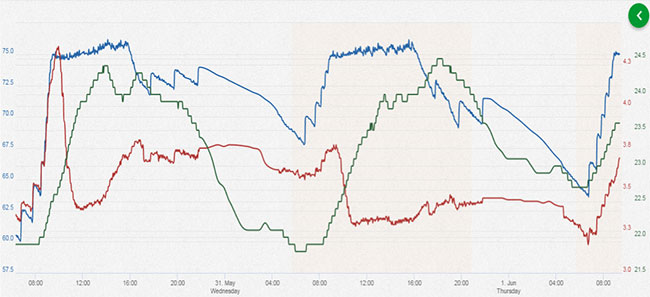
Any grower knows that when plant stress is reduced, a plant will function better. This can be accomplished through applying a structured irrigation strategy per plant growing phase in conjunction with the climate. The first thing to note when analyzing the WC (blue line) in Fig 1 is that there is no WC gradient decrease (purple square) just before the first morning irrigation cycles commence on the different days. This shows that the plants weren’t transpiring when the first irrigation cycle was given, potentially leading to active water uptake or as most growers refer to it, as increased root pressure, which can negatively influence plant physiology. Remember the golden rule, transpiration before irrigation!

Second is the fluctuating morning WC percentage over three days (grey line), varying between 60 and 68% before the morning cycles commence. This varying morning WC percentage creates plant stress that needs to be minimalized, and is determined by the irrigation start and stop times and overnight dry back. A late start and early stop time will generate a steep WC gradient, resulting in a big dry back (black square). In this scenario three night shots were given in Fig 1. to counteract the overnight dry back from becoming too severe, thus avoiding a too-low morning WC percentage. Night cycles are normally applied to compensate for incorrect start and stop times, thus limiting severe overnight WC decreases. It can also be necessary to give night cycles when the substrate volume is on the lean side, and the heating pipes are on, stimulating a generative growing climate and reducing the slab WC.

The morning cycle volume (4 to 6% of the substrate volume) is determined by the previous night’s dry back, and when the two days are compared it is evident that eight cycles were needed on May 31 vs the five cycles on June 1. If the eight cycles were reduced to five to six cycles while increasing the volume, drain would have been realized earlier and simultaneously increased the efficiency of EC control. The large morning cycles will re-saturate the WC in the slab and simultaneously refresh the EC. Also, the large morning cycles (between 4 to 6%) will ensure that drain is realized on time, thus reducing the EC (red line) before noon. It is advised that the irrigation cycles start two to three hours after sunrise and is big enough to realize drain at around 400 J/cm2 or around 600 W/m2, or four to five hours after sunrise. The small irrigation cycles observed in Fig 1. represent a nearly flat line, thus indicating very small dry backs between the cycles. To ensure that the oxygen levels in the slabs are replenished, the WC dry back percentage between the cycles must decrease between 1.5 to 2% before the next irrigation cycle is re-applied. Following this action will ensure that the rootzone stays active, during changing climatic conditions. Also, bear in mind that dissolved oxygen (DO) levels decrease with an increase in water temperature. The decreasing dissolved oxygen (DO) levels in the slabs have a profound negative effect on root formation. Newly formed roots are necessary to ensure the active uptake of water and nutrients – this emphasizes the importance of focusing on start and stop times as well as overnight dry back in conjunction with changing climatic conditions.

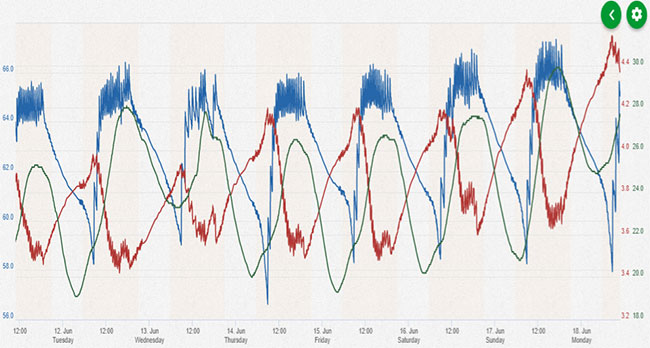
The first key point to focus on when interpreting Fig 2 is the steep WC decrease (between 1 to 2%) which occurs after dawn until the first irrigation cycle starts. Each day tends to have the same curved decrease in WC, and this clearly signifies that the plants were transpiring before irrigation started. It is a well-known fact that root hairs increase the root area and helps with water and nutrient absorption. Also, root hairs are actively initiated after sunrise until the first irrigation, and they are formed within hours. When there is little time from sunrise until first irrigation, root hair formation can be sacrificed. Therefore, it’s important to ensure that plants are actively transpiring before irrigation is activated. The starting WC percentage varies by only 2% over a seven-day period, which has a positive influence on rootzone management during the maximum production phase. This was accomplished despite the changing water temperature (green line) indicating a varying climate, and was achieved by focusing on the irrigation start and stop times and achieving a stable overnight dry back between 7 to 8%.

Although the number of morning irrigation cycles and water temperature (green line) differed between Thursday and Friday, the day dynamic WC percentage stayed stable between 64 to 65%, and it was achieved by changing the number and volume of irrigation cycles needed to reach the day dynamic WC percentage. Thus, the volume and number of irrigation cycles necessary to accomplish this was determined by the overnight WC decrease (dry back). An overnight dry back of between 8 to 10% is adequate to maintain an active rootzone. This is achieved by generating a 3% dry back over a three-hour period since the last irrigation ceased. It is clear to see that the irrigation morning volumes were large enough as the EC was reduced effectively before noon, and was stabilized during the rest of the irrigation cycles. This is paramount, as plant stress is severely reduced by having the lowest EC during the highest radiation. To achieve this, drain must start around 400 J/cm2 or at around 600 W/m2. Although, the irrigation cycles that followed the large morning cycles (blue line) were small, there was sufficient WC dry back between the cycles as the graph amplitudes varied around 1.5%, thus ensuring an oxygenated slab and maintaining an active rootzone during maximum production.

Takeaways
  • Small and large substrate volumes influence the ability to control the WC and EC within the rootzone; small substrate volumes force vegetative irrigation strategies and vice versa
  • The quantity and placement of drain holes per slab will influence the WC percentage steerability and EC refreshment within the slab
  • Irrigation volume strategies are calculated per substrate volume which differs between growers, and large morning cycles between 4 to 6% of the substrate volume is used to re-saturate the WC and refresh the EC, while smaller 3% cycles are used in the afternoon to maintain the day WC and stabilize the EC
  • Maximum production is enhanced by maintaining a stable day dynamic WC and the EC is controlled in a managed way through utilizing a structured irrigation strategy

 
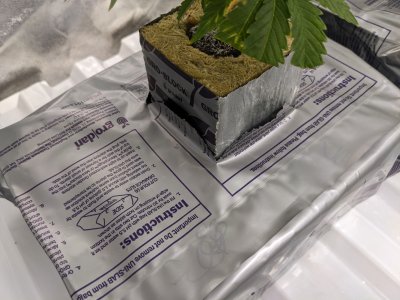
Mounted and ready to run. @Observer you cut an X slightly smaller than the block, fold the corners up, and wrap the block into the slab.
View attachment 19774View attachment 19775

Ahh right, they are meant to set on top and grow in, I was stuck on "insertion" into the holes/slab lmao
-sleep deprived

That's even better I could just load up 4inch cubes or so.


Clean

Ty sir.
 
Man I have no idea what you're doing but it looks cool. I gotta sub to this so I don't need to read a couple pages at a time. I've never seen this grow style before...
He popped some pencil thick roots through some 4"(?) cubes and is now plugging those roots into a larger rhizosphere. My spidey senses keeping saying fertigation........
 
He popped some pencil thick roots through some 4"(?) cubes and is now plugging those roots into a larger rhizosphere. My spidey senses keeping saying fertigation........
Yup those slabs are dope for high-freq-fert and crop steering.

Are you going to be messing with crop steering this round too?

Wanted to attempt it at some point, thought somewhat possible to manually place pot on scale and take a bunch of measurements between the dry-saturated range and record them to get an idea on water content % and manipulate from there, definitely need an E.C meter then.
 
Back
Top Bottom