Bud Builders - Making Friends, Growing Cannabis

Register a free account today to become a Bud Builders member! Once signed in, you'll be able to participate on our site by adding your own topics and posts, as well as connect with other members through your own private inbox.

Join the fun and make some friends!

PH Levels for Cannabis Explained by Aqua Man

OK I'm going to do my best to explain PH since its something that is for the most part greatly misunderstood and can be confusing to new growers and even experienced growers alike. This will explain why we need both ppm and PH meters to give us informed information about PH

This will be a simple guide leaving out a lot of information. So lets get started with a couple of definitions to help you understand.

What is PH?​

PH is a measurement of how alkaline or acid a solution is based on measuring hydrogen ions. It tells us nothing more than the ratio of acidic to alkaline elements. It does not tell us how much of each the solution contains or the alkalinity of the water.

pH at it's core is a measure of the relative amount of free hydrogen and hydroxyl ions ratio. Ie H+ verses OH-. Quantified in molar mass

The pH scale is logarithmic and inversely indicates the activity of hydrogen ions in the solution.

So each, 0.1 increments is either double or half the concentration.... pH 7 to 8 would be a 10x fold increase in OH- ions

Whereas pH 7 to 5 would be a 100x fold increase of H+

pH=−log⁡(H+)≈−log⁡([H+])

Sulfuric hydrogen ion is a great 👍 acidic H+ anchor; Potassium hydroxide is a useful source for the hydroxyl OH- component. But both need to be tightly controlled. ( Contributed by @Franksta )

What is alkalinity?​

Alkalinity is the measurement of the waters buffering capacity (ability to neutralize acids). Its the total amount of carbonate and bicarbonate in the water that affects its ability to resist change to PH. If you know the alkalinity you can actually calculate the amount of acid of varying types needed to reach your target PH but we wont get into that.


So now we have a basic understanding of the difference lets get into some examples of source water and how alkalinity will affect PH.

RO and Distilled water​

Ro and Distilled water is very low in mineral content containing carbonate or bicarbonate sources, we know this because if we test the ppm its usually under 40 and as low as 0ppm. This means it has a very low alkalinity (ability to neutralize acids) and is easily influenced by anything added that's acidic. But likewise it does not contain acid and is easily influenced by anything added that's basic. This results in a very unstable PH that can be easily influenced by anything added or anything its added to. In hydro the ideal ppm of carbonate/bicarbonate sources to provide an adequate buffer will be 50-100ppm with 75ppm being the target. Less than this and PH may swing to fast and be unstable, more and it will not drift enough and will require too much acid that could affect nutrient ratio's negatively depending on the acid used. By adding alkalinity and then acid we provide a more stable PH because adding more of either will have less impact on the overall ratio of acidic to basic elements

When used in hydro it should have alkalinity (a buffer) added back to prevent wild PH swings. Any source of carbonates, bicarbonates, silicates or hydroxides will work to create alkalinity. Sources i would recommend would be calcium carbonate, potassium bicarbonate (commonly sold as PH up) and finally what i would consider the best option is potassium silicate as it is a source of potassium and silica which are both excellent for cannabis. When using RO or distilled you will want to add back some calcium and magnesium if your nutrients are not designed for RO/distilled water as that's usually what Ro filters are removing for the majority. But most cal/mag is in the form of nitrate and provides no alkalinity (buffering capacity) so adding one of the previously mentioned or other is still a must.

When used in soil this unstable PH is actually IMO beneficial if you have a pre buffered soil (which you should) This means the water will have no impact on the PH potential (more on this later) of the soil and will almost instantly be influenced by the soil to the take on the PH of the soil makeup. This is why i feel we do not need to be PHing our nutrient solution for soil grows (unlike soiless and hydro). The soil is what will adjust the PH of our nutrient solution.

Tap Water​

OK we all know tap water varies a lot form place to place and I will explain the basics of how to determine if your tap water is suitable or not for use. First we want the PPM and second we want the makeup of that ppm if available. Generally speaking the majority of the PPM makeup will be calcium carbonate. This is used to buffer the water supply and prevent acidic conditions that erode the coatings and will break down piping and leach them into the water supply such a lead (Flint Michigan ring a bell?) So we can generally assume the majority of the PPM in tap water is likely calcium carbonate but also some others like magnesium, sulfur, phospahte, iron etc. So if you have a ppm of 100-200ppm you can assume roughly 50-75% of that is calcium carbonate. Remember our target is 75ppm carbonate/bicarbonate sources to provide an ideal alkalinity (hope we are starting to see how import alkalinity is and we can't just go by PH) Now there are some cases when some sodium may be used such as sodium bicarbonate aka baking soda (can also be used as a buffer in a pinch but not recommended as a long term option) so we can google our local water report and see the makeup of the ppm in the water.

Soil PH potential​

Now when we buy a prebufferd soil like most of the ones we use they come "Prebuffered" (alkalinity adjusted) what does this mean? This means the company has added amendments that when water is added the resulting PH of the water in the soil will be in a favorable range for growing our plants. Often times peat is used to lower PH and lime is used to raise PH in these soils. Just like in water we want to control the alkalinity (buffering capacity) of the soil to have a stable PH that is not easily influenced by adding things such as nutrients or other. Unlike hydro and soiless where we control the alkalinity (buffering capacity) of the water by adding it directly to the water it is applied to the soil. Which brings me back to my point of we don't need to PH our nutrient solution in soil because the soil provides the buffering and will adjust the PH. Now things like lime and peat break down slowly over time and only soluble elements will impact PH so this is how they control the PH in soil over long periods of time, because it breaks down slowly and only a small amount is soluble at a time its unlikely after a grow it has been depleted. But if we are reusing the soil we should be looking at re amending the buffering capacity before using again to ensure there is enough to last through the next grow. Often times farmers will do this once a year before seeding crops.

Effects of nutrients and source water on PH​

First the PH down acids we use tend to break down much faster than the alkaline sources we use in both hydro and soil. This is one reason we see a hydro systems PH generally rise over time unless something is creating more acid like decaying roots in which case we may actually see PH going down. Typically a PH increase of 0.2 in a 24 hr period is desirable and by adjusting the alkalinity we can control the PH drift. In the case of soil the acids used to bring PH down before feeding break down quickly and the alkaline and acidic buffer we have created minimizes the impact so they are really of not much benefit and have virtually no impact on long term PH potential of the soil. This is why we can't use them to lower high soil PH once we have an alkaline source buildup. However in hydro and coco PHing the nutrient solution is important because unlike soil there is not an adequate buffer established although in coco it is possible to do so.
Generally speaking the ratio's of nutrients we use will be acidic so when we get a buildup of nutrients we will almost always see PH drop. This is where you often hear ppl say flush the media. What this does is dilutes the dissolved elements and will remove some from the media in runoff. Another factor that contributes to PH changes are tge sources of nitrogen used. Ammoniacal nitrogen can cause PH in media to drop. This is due to the release of h+ ions from ion exchange. Whereas Nitrate nitrogen does the opposite and will cause PH in the media to rise when taken up by the plants.

Conversely a water source with high alkalinity can build up in the media and cause the PH potential of the soil to rise over time and in turn the PH of the water added to it. This is the reason we should look at the alkalinity of the water source not the PH as PH cannot measure the potential influence but rather only result.

Often in both circumstances its a good idea to flush the media to remove excess amount of available elements that may be affecting the PH negatively.

I'm gonna stop there and if anyone has questions i will do my best to answer them. If you have something you would like to add please do.


Aqua Man
 
Last edited:
So here are the results:

Overnight stirring PH remained high. PPM stable.

Added in too much PH down. It's now sitting at 2.6. (n)
Going to have to repeat this with my head on the outside of my ass.

However, I found it interesting that KH fell to unmeasurable levels. GH remained high. This was unexpected.
 
So here are the results:

Overnight stirring PH remained high. PPM stable.

Added in too much PH down. It's now sitting at 2.6. (n)
Going to have to repeat this with my head on the outside of my ass.

However, I found it interesting that KH fell to unmeasurable levels. GH remained high. This was unexpected.
Ao the KH plumeted? I think there is going to be more to this. I think this may need done after with the addition of nutrients. Was that before or after the addition of the acid?
 
Last edited:
So I mixed in 10 grams of Agsil and let it set overnight. Last time, 8 grams ended up being close to 100 ppms. This batch still shows 0 after sitting for 12 hours. Did I do something wrong?
 
So I mixed in 10 grams of Agsil and let it set overnight. Last time, 8 grams ended up being close to 100 ppms. This batch still shows 0 after sitting for 12 hours. Did I do something wrong?
Checked my notes and it was actually only 40 ppms last time around after the Agsil. So maybe I'm not too far off. Regardless, there's about 15 grams of it in roughly 20 gallons of RO. I'm currently stirring and will check again when we get back from town.
 
I would like to flesh out the details on buffers in Hydroponics. Started a conversation with @Aqua Man in a grow thread, but probably need to move it here.

I am in search of the best practices for buffer establishment in RDWC. I have been using Potassium Silicate for years now, and it seems to work well to keep PH stable, in conjunction with PH down upon initial res setup. Then over time, the PH tends to fall and needs to be brought back up with more Potassium Silicate (pre-diluted) in Veg and first couple of weeks of flower, then switch to PH up for the end of flower to minimize silica.

There is a website called science in hydroponics that addresses these questions in detail, but not in a succinct way. I would like to dive into the chemistry a bit deeper, and perhaps do some bench testing to verify what we believe. You guys seem like the ones to help me.

So what is the best PH buffer / methodology for hydro?

I have these strips with GH, KH, and PH if we want to try an experiment. I'm also going to get some AgSil 16H on order


Edit, AgSil on order. I no longer have the label for the Potassium Silicate I have, so need to start with a known.

I would add based on ppm instead of PH because once the ph reaches the max for the compiund it wont increase anymore but the concentration will meaning you could have 100ppm of potassium silicate or 1000ppm and the ph woukd be the same
Aqua nails it here Moe


Look at your buffer capacity as dynamic... Like a tree blowing in the wind sorta. As nutrition is uptake and the solution changes it's the ppm that's holding it there

The ppm is the diameter of the tree and the pH swings are the wind....


So just remember earlier in the cycle when you're starting out at low concentration it's going to be really easy to get out of spec fast especially with any type of microbial activity in the res


Personally I just use straight potassium hydroxide for all my strong base needs

Sulfuric and nitric acid are potentially useful strong acid


I think it's worth reviewing strong acid and strong base... And having everything ⚓ anchored. My opinion is sulfuric acid is very helpful
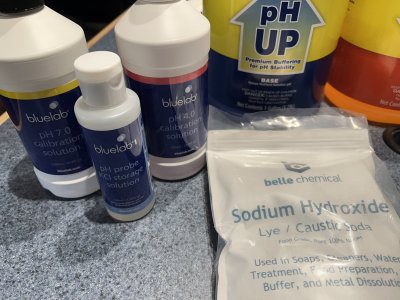

You want to shoot for a combination of strong and weak acid and base components and replace what is being uptake into the plants and surrounding air

So IMO you want the solution firmly anchored on both sides..... Strong acid. Strong base... Weak acid and weak base.... And sulfur (acid) and potassium (base) make the most sense to me
 
Last edited:
Aqua nails it here Moe


Look at your buffer capacity as dynamic... Like a tree blowing in the wind sorta. As nutrition is uptake and the solution changes it's the ppm that's holding it there

The ppm is the diameter of the tree and the pH swings are the wind....


So just remember earlier in the cycle when you're starting out at low concentration it's going to be really easy to get out of spec fast especially with any type of microbial activity in the res


Personally I just use straight potassium hydroxide for all my strong base needs


I think it's worth reviewing strong acid and strong base... And having everything ⚓ anchored to sulfuric acid is helpful


You want to shoot for a combination of strong and weak acid and base components and replace what is being uptake into the plants and surrounding air

So IMO you want the solution firmly anchored on both sides..... Strong acid. Strong base... Weak acid and weak base.... And sulfur and potassium make the most sense to me
I'm pickin up what you guys are layin down...

@Aqua Man I will redo this test today. I will grab an inventory of what acids and bases I have on hand, but I'd love for the 3 of us to put our best foot forward on a precise recipe we can give to folks like Grump and N2. I will test it on the bench, and then I will use it on the next grow as soon as these long ass flowering plants can be harvested.

Frank says Sulfur and Potassium. I'm good with that as long as we can take the potassium into account as a nutrient, it will not be insignificant. Let's make it 4 and invite @Anthem275 in.

So, what is the best practice for setting up a buffer at 5.8 PH? Lets see it happen on the bench and measure it. I promise to get my head out of my ass on this one.

I'll go get pics of acids and bases I have on hand, BRB.
 
I'm pickin up what you guys are layin down...

@Aqua Man I will redo this test today. I will grab an inventory of what acids and bases I have on hand, but I'd love for the 3 of us to put our best foot forward on a precise recipe we can give to folks like Grump and N2. I will test it on the bench, and then I will use it on the next grow as soon as these long ass flowering plants can be harvested.

Frank says Sulfur and Potassium. I'm good with that as long as we can take the potassium into account as a nutrient, it will not be insignificant. Let's make it 4 and invite @Anthem275 in.

So, what is the best practice for setting up a buffer at 5.8 PH? Lets see it happen on the bench and measure it. I promise to get my head out of my ass on this one.

I'll go get pics of acids and bases I have on hand, BRB.
Yeah in in the camp if sulphuric and phosphoric both are very strong, nitric is slightly weaker. I have tried nitric but its a bit weaker and i don’t understand some of the chemistry when using it. I did not find it very stable.

Potassium and silica are 2 nutrients that are always in high demand so i like the potassium silicate but my gut says the potassium hydroxide will be slightly better at buffering PH.
 
Carbonate and bicarbonate are also options but then you ABSOLUTELY MUST avoid citric acid in you ph down.

Like potassium bicarbonate or calcium carbonate there are a lot of options to tinker with.

Potassium silicate i find at a dose of 150ppm and RO to be adequate. With my tap i can get away with 50-100ppm since it contains a decent amount of calcium carbonate
 
I add that early on it's possible nitric acid is the best choice and as the plants change phase it's more sulfur that would be better choice.

getting those element ratios in line while also bending the pH where you want it.
 
Yeah in in the camp if sulphuric and phosphoric both are very strong, nitric is slightly weaker. I have tried nitric but its a bit weaker and i don’t understand some of the chemistry when using it. I did not find it very stable.

Potassium and silica are 2 nutrients that are always in high demand so i like the potassium silicate but my gut says the potassium hydroxide will be slightly better at buffering PH.
I'm thinking it might be a combination of the two

Use the silicate for the base component and just use the hydroxide for adjustment
 
I'm thinking it might be a combination of the two

Use the silicate for the base component and just use the hydroxide for adjustment
Im soo onboard with that and the same goes for acids… a blend of sulphuric, phosphoric and nitric would be the most ideal to keep ratios in check.

Ideal is not always budget friendly and is more complex though
 
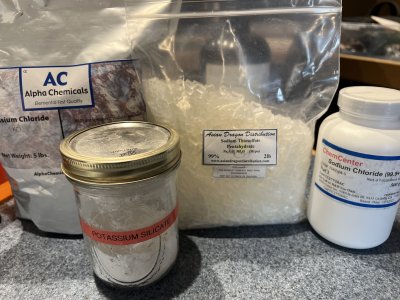
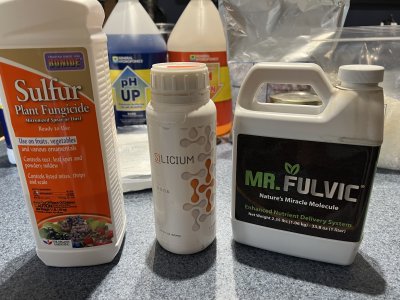
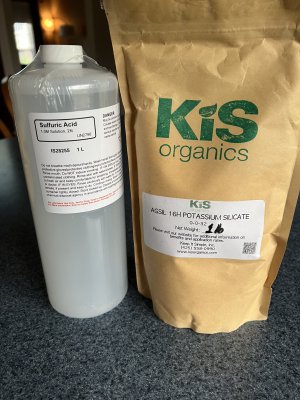
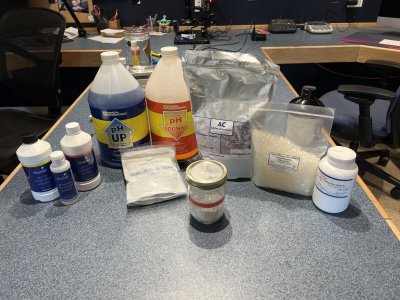
View attachment 5436
View attachment 5433
View attachment 5434
View attachment 5435
I’ve got other assorted things and all flavors of nutes to play with.
Nice… the reason i say we should include nutrients into the mix is because it may play a role in the reactions that are taking place… once we add the plants to this it will also change the dynamics…

As easy as this sounds to test there are so many variables that go into ph its not going to be as simple as we think. Chemical reactions, temperature, aeration concentrations, nutrients and the list goes on and on all can help or hurt our desired PH
 
Nice… the reason i say we should include nutrients into the mix is because it may play a role in the reactions that are taking place… once we add the plants to this it will also change the dynamics…

As easy as this sounds to test there are so many variables that go into ph its not going to be as simple as we think. Chemical reactions, temperature, aeration concentrations, nutrients and the list goes on and on all can help or hurt our desired PH
You said it bubba. Virtually Impossible to tell what is uptake . Just educated guessing and follow the trails and signs
 
Im soo onboard with that and the same goes for acids… a blend of sulphuric, phosphoric and nitric would be the most ideal to keep ratios in check.

Ideal is not always budget friendly and is more complex though
I can get those on order, I do not think I have any pure sulfuric. Or nitric

Phosphoric is PH down, if that is acceptable.

OK I have them both in the amazon cart. Anything else before I place the order?
 
Nice… the reason i say we should include nutrients into the mix is because it may play a role in the reactions that are taking place… once we add the plants to this it will also change the dynamics…

As easy as this sounds to test there are so many variables that go into ph its not going to be as simple as we think. Chemical reactions, temperature, aeration concentrations, nutrients and the list goes on and on all can help or hurt our desired PH
I completely agree with this statement.

I'm also a believer that proving our theory on the bench should be attempted before in the grow.

Why is my KH now 0 after PH down? People running potassium silicate need to know what is happening there.
 
I can get those on order, I do not think I have any pure sulfuric. Or nitric

Phosphoric is PH down, if that is acceptable.

OK I have them both in the amazon cart. Anything else before I place the order?
I used to get nitric from work… it was used for a ph dosser to ensure that the ph was adequate for the sewer system. But we got it in 45gal drums lol. Prob a bit much for this purpose. Lol the first time i put it in a jar and yeah shit ate the fucking lid 😬…. Knowledge gained
 
I completely agree with this statement.

I'm also a believer that proving our theory on the bench should be attempted before in the grow.

Why is my KH now 0 after PH down? People running potassium silicate need to know what is happening there.
How low did you bring the PH?

Also what type of acid? Possibly its a specific reaction to those specific elements?
 
The other end of the puzzle is the nitrate and ammonium ion ratio and what to consider as input

Things like ammonium nitrate would be cost or prohibited to some degree. Unless we can find a pathway that fits the bill.

So alternative is things like ammonium sulfate or calcium nitrate should be considered.

With the right choices you'll have better control over the ratio at different stages of nutrition needs
 
The other end of the puzzle is the nitrate and ammonium ion ratio and what to consider as input

Things like ammonium nitrate would be cost or prohibited to some degree. Unless we can find a pathway that fits the bill.

So alternative is things like ammonium sulfate or calcium nitrate should be considered.

With the right choices you'll have better control over the ratio at different stages of nutrition needs
Yeah the more sources you use the tighter control over ratios you have. Last time i bought ammonium nitrate i had to show ID and i dont even think you can now without a license.
 
So what is the consensus?

I wonder if Potassium Silicate stops being a buffer below 7.

I wonder if the KH I am reading in my res has more to do with the nutes than the "buffer" I think I am adding.

Something I am doing is making my PH more or less stable, but right now I cannot conclusively say what.
 
So what is the consensus?

I wonder if Potassium Silicate stops being a buffer below 7.

I wonder if the KH I am reading in my res has more to do with the nutes than the "buffer" I think I am adding.

Something I am doing is making my PH more or less stable, but right now I cannot conclusively say what.
Can be many things… healthy plants and a good environment increase uptake… the more nitrate taken up the more upward drift you see.

The higher the ppm of nutrients the more stability as less impact on the ratios as they are taken up.

The better gas exchange the more co2 is driven off and not accumulated.

The more ammonium taken up by the plant the more of a downward teend you will see. This can be from nutrient sources, decay of plants and microorganisms.

The more bacteria populations in the water the more microorganisms respiration that consumes o2 and releases co2. This can be significant and will be based off individual species food sources.temperature also had a large effect in this area.

There are lots of tiny clues like seeing bacteria blooms which consume lots of o2 and produce lots of co2 and then you can bet it will follow with die and decay leading to more co2 and ammonium which as stated above will lead to a decline in the ph.

Everyone is going to require a different amount of buffering to cover these impacts specifically to their grow… so I usually start off with 150ppm for RO and 100ppm recommendations for tap of potassium silicate.
 
Everyone is going to require a different amount of buffering to cover these impacts specifically to their grow… so I usually start off with 150ppm for RO and 100ppm recommendations for tap of potassium silicate.
I will do a proper test of 150PPM potassium silicate and PH down tomorrow. Measure KH at the end. I'm hoping for a significant buffer when I get to 5.8. If not, this is all for nothing.
 
Can be many things… healthy plants and a good environment increase uptake… the more nitrate taken up the more upward drift you see.

The higher the ppm of nutrients the more stability as less impact on the ratios as they are taken up.

The better gas exchange the more co2 is driven off and not accumulated.

The more ammonium taken up by the plant the more of a downward teend you will see. This can be from nutrient sources, decay of plants and microorganisms.

The more bacteria populations in the water the more microorganisms respiration that consumes o2 and releases co2. This can be significant and will be based off individual species food sources.temperature also had a large effect in this area.

There are lots of tiny clues like seeing bacteria blooms which consume lots of o2 and produce lots of co2 and then you can bet it will follow with die and decay leading to more co2 and ammonium which as stated above will lead to a decline in the ph.

Everyone is going to require a different amount of buffering to cover these impacts specifically to their grow… so I usually start off with 150ppm for RO and 100ppm recommendations for tap of potassium silicate.
Yeah 👍 that's why I said potassium hydroxide cause especially at the tail end your simply adding in potassium and a hydroxyl OH-component. ... Skip the silicate... Can make a water molecules instead or it's added oxygen and hydrogen at the roots which I believe are in a dynamic state of charges that's useful for uptake


Would be really cool to find hydroponic or lab grade element solution sensors for the following elements. Then use molar mass and the gleaned information to drive the process though the whole cycle

The million dollar question is if there anything available on the market for such a use


  • Nitrogen (N)
  • Potassium (K)
  • Phosphorus (P)
  • Calcium (Ca)
  • Magnesium (Mg)
  • Sulphur (S)
  • Iron (Fe)
  • Manganese (Mn)
  • Copper (Cu)
  • Zinc (Zn)
  • Molybdate (Mo)
  • Boron (B)
  • Chlorine (Cl)

Even just sensor for the top five could be such a boon of information to analyze
 
Last edited:
Yeah 👍 that's why I said potassium hydroxide cause especially at the tail end your simply adding in potassium and a hydroxyl OH-component. ... Skip the silicate... Can make a water molecules instead or it's added oxygen and hydrogen at the roots which I believe are in a dynamic state of charges that's useful for uptake


Would be really cool to find hydroponic or lab grade element solution sensors for the following elements. Then use molar mass and the gleaned information to drive the process though the whole cycle

The million dollar question is if there anything available on the market for such a use


  • Nitrogen (N)
  • Potassium (K)
  • Phosphorus (P)
  • Calcium (Ca)
  • Magnesium (Mg)
  • Sulphur (S)
  • Iron (Fe)
  • Manganese (Mn)
  • Copper (Cu)
  • Zinc (Zn)
  • Molybdate (Mo)
  • Boron (B)
  • Chlorine (Cl)
I forget the name of them but @Moe.Red may remember… i talked about them with him… can actually test the levels in the plants from sap
 
Yes there are sap sensors for 4 of those.

I think frank is talking about res sensors. Those are not available or available at a price point I would be willing to invest in.

Holy hell the irony. You need to mortgage the farm for the meters.

Anyone got $2500 laying around somewhere in a hole waiting to be spent? 😆. There deluxe DUAL SENSOR lol. Probably two wrong number half the time


keep it Calibrated for the win. But I suspect it's expensive also
 
Each sensor has a half dozen calibration items for $99 each


My guess is we can find something from China for less cost. Just need to find the right person

It's a lot of money 💰 but the information gleaned can be valuable
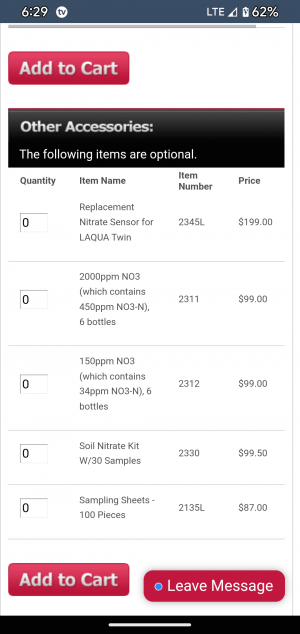
Screenshot_20230604-182951.png
 
Would be really cool to make stuff like this affordable for everyone and find a manufacturer that would partner


This could almost be like AI for cannabis 😆

I suspect all those sensors can be built for under $100 each
I looked into this hard for a month. These sensors are not available off the shelf to integrate into your own system. I’d probably be better off to do a spectrscopy from a test strip with all the right pads to keep it cheap.
 
Back
Top Bottom